
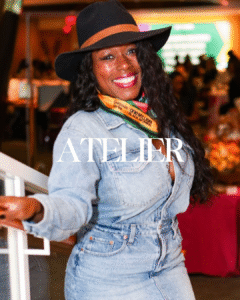
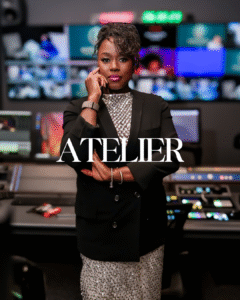
Four years ago, Angel Livas set out with a mission: create a home for Black content creators. Today, that mission has a physical address — just steps from the White House.
Livas, a journalist-turned-media tech founder with 26 years in the industry, is the founder and executive behind ALIVE Podcast Network, a growing media platform that has evolved from an audio-first streaming app into a full-scale media enterprise. This year, ALIVE celebrates its four-year anniversary alongside a major milestone — the opening of ALIVE Studios inside the Ronald Reagan Building in Washington, D.C.
“The idea was having a home for Black voices,” Livas told Atelier Magazine. “To literally have a home for Black voices inside the Reagan Building — that’s something else.”
From App to Empire
ALIVE began with a proprietary app available on iOS and Android, built around the belief that Black podcasters deserved a platform where they could maintain ownership and actually monetize their content. The goal, Livas explained, was to keep creators in the game longer — preventing the burnout that comes from building an audience with no financial return.
From there, the network expanded into connected television. ALIVE’s content is now available on Roku devices, Apple TV, Fire TV, and Samsung TV through CTV distribution — giving its creators a reach far beyond their original podcast audience.
The Washington, D.C. studio represents the network’s most ambitious step yet. More than just a production space, ALIVE Studios is designed to serve as a hub for Black media organizations that need a presence in the nation’s capital. The facility includes editing bays and live broadcast capabilities, enabling media outlets to conduct White House correspondent work, turn around breaking stories, and send live feeds to production companies around the world — all from a Black-owned facility in the heart of D.C.
“If a publication has boots on the ground in D.C., and they have a White House correspondent but no hub — now they know there’s a Black-owned media house, production house, just steps away from the White House,” Livas said.
ALIVE & Well: A Debut That Turned Heads
Beyond the studio expansion, Livas launched ALIVE & Well — a wellness-focused show she describes as “a sanctuary for mind, body, and spirit” — and the debut could not have gone better. The premiere was extremely well received, and it set the tone for exactly the kind of storytelling Livas envisioned when she created the series.
The debut episode featured Dawn Myers, entrepreneur, Shark Tank winner, and founder of Richualist, a celebrated hair product brand built around the needs of textured hair. Myers’ story embodied everything ALIVE & Well stands for: a founder who identified a gap, built a solution from personal experience, and turned it into a thriving business.
But don’t mistake the show for typical wellness programming. The series focuses on founders and innovators who have built solutions rooted in lived experience — particularly within the Black community.
Livas shared additional examples that shaped the show’s vision. Her fiancé, a scientist whose daughters have a rare genetic eye disease called retinitis pigmentosa, founded a company dedicated to increasing minority participation in clinical trials — because without that representation, treatments that could help the Black community may never be developed. Another story features a woman who created mastectomy implants in diverse skin tones, after watching her grandmother feel alienated by the standard white-only options available after a breast cancer surgery.
“The goal of ALIVE & Well is to tell the stories of these amazing founders who are creating solutions to problems in all aspects of life,” Livas said. “It’s also about how they stay fluid when they’re battling their own imposter syndrome and everything else life throws at us.”
The Three Pillars
Selecting which creators and stories belong on ALIVE is guided by what Livas calls the network’s three pillars: information, innovation, and inspiration.
“I feel like there’s enough messy TV,” she said plainly. “My goal was to create content that would be inspiring, informational, and spark innovation.”
The framework ensures that everything on the platform — even content that ventures into more candid or provocative territory — reflects an authentic voice and leaves viewers feeling seen. “When people watch or listen to any of our content, they see a reflection of them or someone they know where it resonates,” Livas explained. “That’s often the divide — if I don’t see a glimpse of myself, I may not come back.”
Badges, Marketplaces, and the Divine Dozen
ALIVE is also launching a marketplace and recognition program tied directly to ALIVE & Well. The program offers two tiers of recognition: a Curator Badge for brands whose products are vetted and endorsed by the network, and a higher-tier Eminence Badge, awarded monthly to one organization or founder making a meaningful impact in the community.
Eminence Badge recipients are featured guests on ALIVE & Well, receiving a full episode to share their story and demonstrate their product or service. At year’s end, all twelve monthly recipients — what Livas calls the “Divine Dozen” — are celebrated together.
“I figured, if some of these stories are this powerful, how would that increase their sales if we amplified what it is that they’re doing, why they do it, and how it could be beneficial to our community?” she said. “My goal is to stimulate the Black creative economy.”
Hard Lessons as a Non-Technical Founder
The road to building a media tech company wasn’t without its costs. Livas was candid about the steep learning curve she faced as a seasoned media executive stepping into the world of technology.
“You have to know how to articulate exactly what you want,” she said. “Otherwise, you lose money — and I did. Or you get a product you didn’t want — and I did.”
She cautioned other non-technical founders about a common pitfall: developers who confidently say they can build something, then figure it out on the fly — at the client’s expense. “They’re not gonna say ‘I don’t know how to do that.’ They’re gonna say, ‘Yeah, I got you.'”
It’s already difficult for Black founders to raise capital, she noted, making it even more critical to be intentional about how every dollar is spent. Accelerators like Techstars, she said, helped provide the mentorship and guidance that kept ALIVE on course.
Vision for the Next Five Years
Looking ahead, Livas envisions ALIVE Studios expanding to additional cities — and she has a specific idea for how those spaces should function. She wants them to operate as dual-use facilities where major productions and up-and-coming creatives share the same building.
“What would happen if you brought us all together?” she asked. “If you had the opportunity to shadow these larger productions, how much faster could you grow? How much faster could you possibly see — I was doing this for fun, but I actually see a future for me here?”
For Livas, it’s personal. “I know when I was in college, if I had a place I could go where a major show was being produced in the same house where I’m doing my recordings — that’s gonna make me feel even more powerful. That’s going to make me feel like I don’t have as many limitations that are sometimes imposed on us.”
To connect with ALIVE Podcast Network or inquire about studio access in Washington, D.C., visit: alivepodcastnetwork.com