
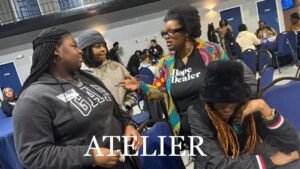
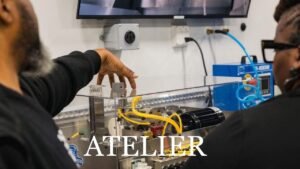
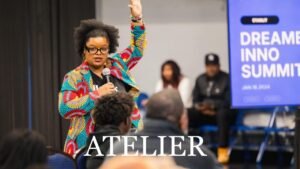
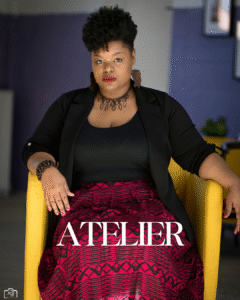
In meeting rooms and community spaces, inside classrooms, churches, and innovation hubs, Freda Hendley-Reeves—known to most simply as Free—is often less concerned with introducing new technology than with asking a quieter question: who understands it, and who gets left out when they don’t? The answer has shaped much of her work over the past decade. While conversations around artificial intelligence often center on speed and scale, Hendley-Reeves has focused on translation—how emerging tools move from technical spaces into everyday use, and what happens when communities are equipped to participate rather than observe.
Her work sits at an intersection that has historically been fragmented: technology, workforce development, entrepreneurship, media, and faith-based community life. Rather than treating these as separate lanes, she approaches them as parts of a single system. The result is less a personal profile than a body of work built around infrastructure—programs, partnerships, and learning environments designed to make access practical.
From Storytelling to Systems Thinking
Hendley-Reeves’ career has evolved through communications, media, and strategic development, but storytelling remains central to how she operates. Not storytelling as promotion, but as framing—how communities understand change and their place within it.
Early work in media and artist development sharpened her understanding of narrative as both opportunity and responsibility. Working alongside artists and creative teams, including collaborations with producer and creative partner Delandrian Aikens, she operated in spaces where public perception and timing could shape outcomes as much as talent itself. Artist development, in this context, extended beyond creative direction. It involved helping artists navigate visibility, messaging, and moments when public narratives shifted quickly.
That experience later informed her work in crisis communications and strategic storytelling, where the stakes extended beyond entertainment into organizational leadership and community-facing institutions. The throughline remained consistent: stories shape outcomes. Whether supporting artists, founders, or organizations, Hendley-Reeves’ work focused on helping people communicate clearly during periods of transition.
Over time, that perspective expanded beyond media into innovation ecosystems. She became increasingly aware that technological change followed a similar pattern. Tools moved quickly, but understanding lagged behind. Artificial intelligence, in particular, arrived with both promise and uncertainty, often discussed in ways that felt distant from everyday work.
Rather than positioning technology as something to be mastered by specialists, she began focusing on education models that made complex systems understandable and usable within real environments.
AI Education and Workforce Readiness
In her work with AI education initiatives and workforce-focused programming, Hendley-Reeves has emphasized accessibility without oversimplification. Certification programs, study groups, and applied learning cohorts are framed not as credentials alone but as entry points into confidence—giving professionals language and practical understanding that allows them to participate in decisions around AI implementation.
This emphasis reflects a recognition that technological change rarely happens evenly. Large companies often have internal resources to experiment and adapt, while smaller organizations and community-based enterprises face steeper learning curves. By bringing executives, entrepreneurs, and emerging professionals into shared learning environments, her programs create spaces where implementation becomes visible rather than abstract.
As artificial intelligence becomes embedded in everyday operations, literacy increasingly determines participation. Hendley-Reeves’ work positions education as a form of infrastructure, enabling communities to engage with technological change rather than reacting to it after the fact.
Artists, Media, and Technology as Cultural Bridge
Parallel to her workforce and innovation work, Hendley-Reeves has remained active within creative ecosystems, particularly through artist collaboration and cultural programming. The Soul Sessions entertainment series, developed in partnership with Delandrian Aikens, reflects this intersection. Framed as live entertainment experiences, the series functions as both cultural gathering and fundraising platform, using music and performance to support community initiatives while introducing conversations around entrepreneurship, technology, and AI awareness to audiences who may not otherwise encounter them in formal settings.
This blending of culture and education reflects a consistent philosophy in her work: people engage with ideas more openly when they encounter them in familiar environments. Entertainment becomes an entry point for dialogue rather than an endpoint.
That philosophy also informs the development of Starlit Digital, a platform envisioned as a faith-centered streaming ecosystem combining video, music, and written content in a format comparable to mainstream digital marketplaces. Designed to house faith-based storytelling, educational content, and creative work, the platform reflects Hendley-Reeves’ interest in ownership and distribution—creating spaces where artists, educators, and ministries can maintain control over their narratives while adapting to digital consumption patterns.
In this context, technology serves creative and spiritual expression rather than replacing it. The goal is not simply content delivery, but the cultivation of an ecosystem where creators and communities remain connected to the purpose behind the work.
The Smart Church Model
The clearest expression of Hendley-Reeves’ systems thinking is the Smart Church initiative, a long-term framework that reimagines the role of faith institutions within modern community ecosystems.
Rather than approaching churches solely as spiritual centers, the model treats them as anchors for economic and social development—places where education, agriculture, technology training, entrepreneurship, and cultural programming can coexist. Historically, Black churches have functioned as centers of organizing, education, and economic support. The Smart Church framework asks what that role looks like in an era shaped by artificial intelligence, sustainability concerns, and shifting workforce realities.
In practice, the concept includes STEAM education programs, AI literacy training, entrepreneurship development, and sustainable food initiatives operating alongside ministry. Technology becomes a tool for stewardship and stability rather than an external force reshaping community life from the outside.
What distinguishes the initiative is its emphasis on implementation over theory. The vision unfolds through partnerships, pilot programs, and incremental development, acknowledging that community transformation requires time and trust.
Technology, Faith, and Cultural Change
Hendley-Reeves’ work arrives at a moment when institutions across sectors are reexamining their relevance. Workplaces are changing under technological pressure. Creative industries are renegotiating ownership and distribution. Faith institutions are navigating how to remain central in people’s daily lives.
Her approach suggests that these challenges are connected. Technology changes how people work, which changes how communities gather, which in turn reshapes how institutions serve them. Addressing one without the others creates imbalance.
By framing artificial intelligence and entrepreneurship within familiar cultural structures—churches, creative platforms, and community-centered programming—her work reduces the distance between innovation and lived experience. Technology becomes functional rather than aspirational.
Momentum and Long-Term Vision
There is no singular project that defines Hendley-Reeves’ work because the work itself is iterative. Programs evolve. Creative platforms expand. Partnerships shift as new needs emerge. The throughline remains consistent: building environments where people can engage with change without being displaced by it.
In conversations about artificial intelligence, the future is often described in abstract terms. Hendley-Reeves’ work pulls those ideas back to ground level, asking what they mean for entrepreneurs, artists, and communities working to build stability in uncertain times.
The momentum surrounding AI, media, and community development continues to accelerate. Her focus remains steady. Technology will continue to change. The more pressing question is whether communities are prepared to change with it.
Hendley-Reeves is also the author of Unlocking The Intangible Tangibles: Simple Strategies for Transforming Invisible Assets into Real Success (https://a.co/d/03MohUNv) and The Smart Church Manual: AI Edition: A Faith-Based Leadership Guide to Building a Spirit-Led, Future-Ready Ministry (https://a.co/d/0bnieibC), extending her work into written frameworks that connect faith, leadership, and emerging technology.
For Hendley-Reeves, the answer lies not in predicting what comes next, but in building systems capable of adapting when it arrives.