

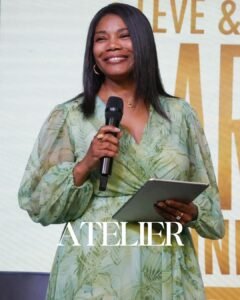

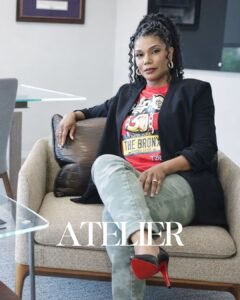

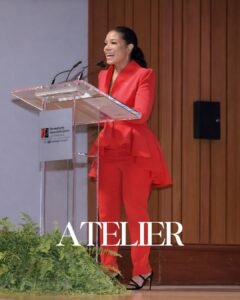
The conversation begins where many stories about New York eventually do, somewhere between music and movement. Before the boardrooms, before operational strategy and institutional leadership, there was a younger Shawn Cumberbatch-Graham in the Bronx, moving to music on sidewalks and in community spaces where rhythm was currency and confidence was learned early.
She laughs when the subject comes up. The image surprises people now, she admits. The Executive Vice President and Chief Operating Officer of the Russell Innovation Center for Entrepreneurs once spent her afternoons breakdancing, part of a generation shaped by the early language of hip-hop culture. But for her, being a B-girl was never about performance alone. It was discipline. It was timing. It was understanding when to lead and when to move with the rhythm around you.
“In the Bronx, you learned quickly that you had to know who you were,” she says, not as nostalgia but as context. The culture demanded originality, but it also demanded respect. That balance—confidence grounded in preparation—would become a through line in her life long after the music faded into memory.
The Bronx of her childhood was a place where style carried meaning. Fashion was expression, aspiration, and identity all at once. She remembers admiring Beverly Johnson, seeing in her a kind of elegance that felt both powerful and attainable. But it was Diahann Carroll who left the deepest impression. Carroll, also a Bronx native, represented something larger than beauty or celebrity. As a child watching Julia, Cumberbatch-Graham saw one of the first images of a Black woman leading her own narrative on television. The image stayed with her.
“It was the first time I remember seeing someone who looked like us, living with dignity and professionalism on screen,” she recalls. That early exposure to representation mattered. It expanded what seemed possible before she had language for ambition.
Equally influential was home. Her mother’s work ethic set a standard that never required explanation. Hard work was not framed as sacrifice but as responsibility. Watching that consistency shaped how Cumberbatch-Graham would later approach leadership. The composure people now recognize in boardrooms—the calm, measured presence—has roots in those early lessons about showing up prepared and doing the work whether anyone was watching or not.
The path from the Bronx to executive leadership was not linear. Her career moved through corporate and nonprofit spaces where finance and operations became her tools for understanding how organizations succeed or fail. Accounting, she explains, taught her to see beyond surface narratives. Numbers reveal priorities. They show where investment exists and where it does not. Over time, she became less interested in managing systems and more interested in building ones that worked better for the people inside them.
That perspective now defines her work at the Russell Innovation Center for Entrepreneurs in Atlanta. RICE, as it’s known, operates as both institution and ecosystem, supporting entrepreneurs while navigating the realities of growth, sustainability, and access. As EVP and COO, Cumberbatch-Graham focuses on the infrastructure that allows vision to become reality. The work is not glamorous, she says, but it is necessary. Without structure, opportunity cannot scale.
Her leadership as Principal Investigator for the Georgia Artificial Intelligence in Manufacturing Project 3 Mobile Studio reflects that same philosophy. The project brings emerging technology directly into communities across Georgia, creating hands-on exposure to tools that often feel distant or inaccessible. She speaks about it less as innovation and more as preparation. People cannot participate in futures they have never seen. The studio, in her view, removes that barrier.
The conversation moves easily between professional milestones and cultural touchstones. Music still plays a role in how she thinks about movement and progress. Curtis Mayfield’s “People Get Ready” comes up as a quiet theme—less a favorite song than a reminder that preparation is ongoing. Success is rarely sudden. It is built over time, through consistency and readiness.
The conversation moves easily between professional milestones and cultural touchstones. Music still plays a role in how she thinks about movement and progress. Curtis Mayfield’s “People Get Ready” comes up as a quiet theme—less a favorite song than a reminder that preparation is ongoing. Success is rarely sudden. It is built over time, through consistency and readiness.
There is also admiration for women who have carried authenticity into public life without compromise. Michelle Obama, Angela Davis, Shirley Chisholm, and Maya Angelou appear in the conversation not as distant icons but as examples of presence and purpose. Viola Davis, too, represents something familiar: excellence rooted in honesty rather than performance.
Despite the scope of her work, grounding remains personal. Gospel music, family time, and moments with her grandchildren provide balance. Leadership, she says, becomes clearer when life exists beyond work. It reminds her what the work is for in the first place.
What becomes clear over the course of the conversation is that the cultural class people now associate with Shawn Cumberbatch-Graham—the ease, the composure, the sense of control—is not accidental. It was formed early, shaped by music, representation, and the example of a hardworking mother who modeled resilience without ceremony. The B-girl from the Bronx never disappeared. She simply learned how to carry rhythm into different rooms.
Today, whether guiding operations at RICE or helping shape initiatives that expand access to entrepreneurship and emerging technology, her approach remains consistent. Leadership, for her, is not about visibility. It is about preparation, discipline, and making space for others to move forward.There
is no definitive ending to the story, only continuation. The work evolves, the
impact widens, and the rhythm keeps moving. As she puts it with a quiet smile,
some lessons never leave you. You learn the beat early. The rest is learning
how to move with it.